
Remote workers who want more than a 90-day tourist stay in Costa Rica have one clear route. The Costa Rica digital nomad visa is an immigration category called Estancia for Remote Workers and Service Providers. It lets qualifying foreigners stay for a year, with one renewal, as long as they prove steady income from outside the country. This guide covers who qualifies, what the income test measures, which documents carry the application, what it costs and how long you can stay.
The rules below come from the official Visit Costa Rica pages that describe the category. Fees and requirements can change, so treat the numbers as a planning baseline and confirm them with the immigration directorate before you apply. If you are still choosing where to base yourself, the guide to the best digital nomad cities for 2026 compares other options.

The Costa Rica digital nomad visa rests on one number: $3,000 a month from outside Costa Rica
The core test is income. Applicants must show at least $3,000 a month for paid remote work, and the money must come from outside Costa Rica. Applicants with dependents must show at least $4,000 a month. The official requirements page also says amounts are converted at the Central Bank of Costa Rica's official sale price.
That conversion detail is the non-obvious part. A freelancer paid in euros or pounds can sit above the line in one month and below it in another, because the exchange rate moves while the threshold stays fixed in US dollars. If your income is close to $3,000, check the Central Bank rate against your statements before you pay for translations and legalization.
Income also has to be steady. The application asks for bank statements that show the required monthly income across the prior year. A strong final quarter after a thin year may not carry the file, so the earlier months matter as much as the recent ones.
The threshold is a floor, not a target. A file that clears $3,000 by a thin margin has little room for a currency swing or a slow month, while a file with a comfortable gap is easier to defend. If your income sits near the line, build a buffer in the months before you apply, or wait until the prior-year statements show a steadier pattern.
Here is how the thresholds compare at a glance.
| Applicant | Minimum monthly income | Where the income must come from |
|---|---|---|
| Single applicant | $3,000 (USD) | Outside Costa Rica |
| Applicant with dependents | $4,000 (USD) | Outside Costa Rica |
Source: Visit Costa Rica, digital nomad requirements

Only remote work for clients outside Costa Rica counts
Who qualifies comes down to who pays you. The category is written for foreign nationals who provide paid services remotely, using digital or telecommunication tools, to a person or company located outside Costa Rica. It applies whether you are an employee, a contractor or a freelancer, and whether the work is subcontracted or not.
The wording is broad on purpose. The official text does not limit the category to one profession, so the test is the relationship between you and the payer, not your job title. What matters is that the person or company paying you sits outside Costa Rica and that the services are delivered through digital or telecommunication means.
A few profiles fit the wording well. A developer on a US payroll, a designer billing agencies in Europe and a consultant with several foreign clients all earn from outside the country. A person who plans to take local Costa Rican clients, or to run a business that sells inside the country, does not fit the category as the official page describes it.
Dependents can join the application. The overview page notes that dependents must be covered by the medical policy, and the higher $4,000 threshold applies when you apply with them. Anyone who does not meet the income test can still enter as a tourist, but that stay is limited to the standard 90 days.
Check before you travel: visa categories, income thresholds and fees change. Confirm each figure with the immigration directorate (DGME) before you book flights or pay any fee. The Visit Costa Rica overview is a good starting point for the current summary.

A year of bank statements and a sworn affidavit carry most of the application
The paperwork is where applications slow down. The requirements page lists the following items.
- The application form, signed by you or your representative. It can be filed online through the Tramite Ya platform or on paper at a DGME office.
- Proof of the $100 government payment.
- A copy of your passport photo page, plus the entry-stamp page if you are already in Costa Rica.
- Any consular or restricted visa your nationality requires.
- Bank statements from the prior year with a sworn affidavit showing the required monthly income, or a certification from a public accountant or notary.
- Official Spanish translations of any document in another language.
The accountant or notary route needs consular legalization or an apostille. That step adds time, because the certificate has to be issued, apostilled and then translated before it can be filed. Starting the document chain early is the simplest way to avoid a stalled file.
Two documents deserve extra attention. The first is the affidavit or certification, because it is the only paper that ties your bank records to the income claim. A statement alone shows deposits, while the sworn text or the professional certification explains that they are monthly earnings for remote services. The second is the translation. Every foreign-language page needs an official Spanish version, so count the pages before you order and ask the translator for a price per page.
Mixed income sources need a clean paper trail. If you bill several clients through one account, label the deposits in a short cover note so the reviewer can see that each one comes from outside Costa Rica. If you are paid through a platform, include the platform's payout statements alongside the bank record so the two documents agree.
For minors or children with disabilities, the parent signs the form, or a representative files with a power of attorney. Keep scans of every page you submit so you can answer a request for missing items quickly.

What the Costa Rica digital nomad visa costs: a $100 payment, bank fees and a $50,000 medical policy
Prices checked on 24 November 2026 against the official Visit Costa Rica requirements page. The government payment is $100, or the colon equivalent at the Central Bank reference rate, under Article 256 of the General Law of Migration and Foreigners.
International transfers need care. The full $100 must reach the Ministry of Finance, so the sending bank's fees and a $15 receiving-bank fee at Banco de Costa Rica are paid in addition. Budget for roughly $115 plus your own bank's charge, and ask your bank to send the payment so the net amount arrives in full.
Insurance is the larger cost. The overview page says the policy must cover you for the entire authorized stay, with a minimum of US$50,000, and dependents must be covered too. It can come from an international provider or from a Costa Rican insurer regulated by the national insurance regulator. The policy price depends on your age, plan and provider, so get quotes before you commit.
| Item | Amount | Note |
|---|---|---|
| Government payment | $100 (USD) per applicant | Or the colon equivalent |
| Receiving-bank fee on transfers | $15 (USD) | Plus your sending bank's fees |
| Medical policy coverage | At least US$50,000 | Whole stay, dependents included |
| Guarantee deposit | Set by regulation | Amount not stated on the pages reviewed |
Source: Visit Costa Rica, requirements, overview and immigration document pages
The guarantee deposit is easy to miss. The immigration document page says a single guarantee deposit receipt is part of the paperwork, set under the deposit fund regulation. It does not print the amount, so confirm the figure with the DGME before you plan your total budget.
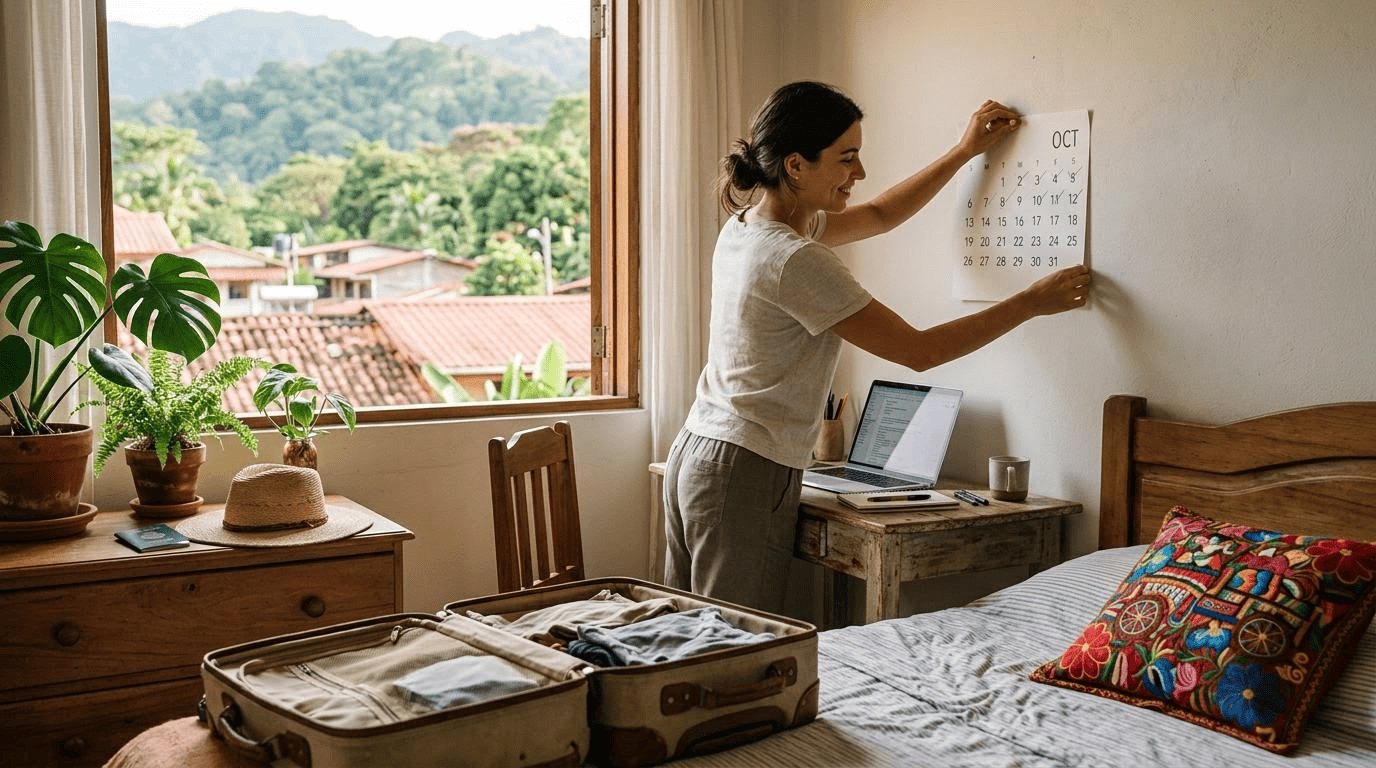
Stay length: one year, one renewal and three months to finish accreditation
The visa turns the standard 90-day tourist stay into a year, with an option to renew for a second year, according to the Visit Costa Rica overview. That gives remote workers a possible two-year base without leaving the country for a border run.
There is also a clock after approval. Once the DGME notifies you of a decision, you have three months to complete the immigration accreditation document, or the office starts procedures to cancel the status. The immigration document page spells this out, and it is the step that catches people who treat approval as the finish line.
The application itself moves fast on paper. The procedure page gives the office 15 calendar days from submission to issue a written decision. Within the first 5 calendar days it sends one notice listing missing items, and you then have 8 working days to respond. If you miss that window, the application is rejected and the file is archived.
You apply either online or in person. Online applicants register on the digital platform and give informed consent. In-person applicants book an appointment through the DGME web portal and attend the central offices in La Uruca or a regional office, as the procedure page explains.
The official pages reviewed for this guide do not state how many days you must spend in Costa Rica to qualify for the renewal. Ask the DGME for the current rule before you plan a long trip abroad during the first year.
Working backward from those deadlines gives a sensible order of operations. The sequence below follows the steps the official pages describe.
- Check your income record. Pull a year of statements, convert foreign-currency income at the Central Bank sale price and confirm every month clears the threshold you need.
- Price the medical policy. Request quotes that show the $50,000 minimum, the full length of the stay and cover for each dependent.
- Start the document chain. Order the sworn affidavit or the accountant or notary certification, then arrange the apostille or legalization and the official Spanish translations.
- Make the $100 payment. Send it so the full amount arrives net of bank fees, and keep the receipt for the file.
- File the application. Register on the digital platform with informed consent, or book a DGME appointment and attend in person.
- Answer any notice fast. The office has 5 calendar days to flag missing items and you have 8 working days to reply.
- Finish accreditation. After the decision notice, complete the immigration document within three months.
Most delays trace back to steps three and four. Apostilles and translations take the longest, and a payment that arrives short because of bank fees can force a second transfer. Treat those two items as the critical path and the rest of the timeline gets easier.
Check before you travel: the three-month accreditation window and the 8-working-day reply window are strict deadlines. Set calendar reminders on the day you receive any notice.

A first-year plan: base in the Central Valley and keep weekends for the volcano country
Consider a hypothetical applicant who bills two foreign clients about $3,400 a month. She files online, receives approval, completes accreditation inside the three-month window and then settles into a rental near San Jose. A long stay changes how you plan: with a year available, you can work Monday to Friday and keep weekends for slower trips instead of cramming everything into two weeks.
The tax position helps the budget. Visit Costa Rica says digital nomads are exempt from income tax, and it adds that duty on telecommunications and electronic devices needed for remote work may be waived, subject to conditions. The same page notes that holders can open a national bank account and validate a home driver's license.
The Arenal area near La Fortuna is one weekend option for a long-stay visitor. If you prefer a guided day to arranging transport yourself, you can compare a full-day trip that combines a waterfall, the Arenal volcano area and hot springs on this Viator tour listing. Check what is included, the pickup points and the current price on the listing before you book, since tours and rates change.
Keep weekend travel inside your budget model. Hold a fixed monthly amount for trips, and keep the medical policy documents with you when you travel inside the country.
The practical perks of the status add up over a year. A national bank account makes local rent and utilities easier to pay, and a validated home driver's license can simplify getting around outside the capital. Both benefits are listed on the official overview, so confirm the current conditions for each one when you arrive.
A long stay also changes the work side of the plan. Reliable internet matters more than a view when client calls fill your week, so test connection speeds at any rental before you sign a long lease. Plan a backup, such as a mobile data plan or a coworking membership, so a single outage does not cost you a client deadline.
Finally, think about timing. Because the decision window is short and accreditation has a three-month limit, line up your housing search for after approval rather than before. Short first-month rentals let you compare neighborhoods and commute times without locking in a year of rent.

Is the Costa Rica digital nomad visa worth the paperwork?
It suits remote workers who already earn $3,000 or more a month from foreign clients, can document a full year of that income and want a stay longer than 90 days. The upfront costs are modest, since the government payment is $100, but the insurance requirement and the document chain take the most time and planning.
The decision also depends on how you like to work. A one-year status rewards people who want a settled routine, a fixed address and a local bank account. People who prefer to move every few weeks may find a series of tourist stays more flexible, even though each stay is limited to 90 days.
It suits people less well if income is irregular, if clients are local or if the income sits just above the threshold in a volatile currency. In those cases, a shorter tourist stay may be the safer plan until the income record is stronger. Before applying, confirm the guarantee deposit amount, the renewal presence rule and the current fees with the DGME.
Frequently Asked Questions
How much income do you need for the Costa Rica digital nomad visa?
You need at least $3,000 a month earned from outside Costa Rica if you apply alone. The figure rises to $4,000 a month if you apply with dependents.
How long can you stay on the Costa Rica digital nomad visa?
The stay is one year, and Visit Costa Rica says you can renew it for one more year. That turns the usual 90-day tourist stay into a stay of up to two years.
How much does the Costa Rica digital nomad visa cost?
The government payment is $100 for each applicant. A medical policy and a guarantee deposit are separate costs, and bank fees on an international transfer come on top of the $100.
Can you work for Costa Rican clients on this visa?
The category covers paid remote services for a person or company located outside Costa Rica, and the income must originate outside the country. Local clients do not fit the rule as the official page describes it.
Is health insurance required for the Costa Rica digital nomad visa?
Yes. Visit Costa Rica lists a medical policy that covers you and any dependents for the full authorized stay, with a minimum of US$50,000.
Do digital nomads pay income tax in Costa Rica?
Visit Costa Rica says digital nomads are exempt from income tax. Rules in your home country still apply, so confirm them with a tax adviser.
How do you apply for the Costa Rica digital nomad visa?
You register on the digital platform and give informed consent, or you book an appointment through the immigration directorate's web portal and file in person with your documents.
References
- Visit Costa Rica, Digital Nomads Requirements
- Visit Costa Rica, Digital Nomads: Live and Work
- Visit Costa Rica, Digital Nomads Issuance of the Immigration Document
- Visit Costa Rica, Procedure