
A four-year-old and a seven-year-old rarely care which century a cathedral dates from. They care about naps, snacks and whether a playground sits within ten minutes of the hotel. That is the real test for europe family friendly vacations: not which country has the most sights, but which one keeps transfers short, meals flexible and costs predictable for children under 10.
This guide compares five destinations for a first family trip: Denmark, the Netherlands, Italy, Spain and Croatia. It draws on official operator pages for child fares and entry rules, all checked on 25 November 2026, and adds an editor's comparison of what each place asks of a family with small children. Nothing here comes from a personal trip, and every price or rule needs a final check with the provider before you book. For a wider plan of a first trip across the continent, read the Europe travel guide for first timers alongside this one.

Why europe family friendly vacations work best with one base per four nights
Children under 10 change the maths of a European trip. Adults put up with a 7 a.m. train and a 9 p.m. dinner. A five-year-old does not, and a toddler tolerates neither for long. The country matters, but the number of times you pack a suitcase matters more.
Each hotel change costs roughly half a day once you count checkout, transit, check-in and the afternoon slump. A family that changes beds four times in a week loses two full days to moving. Two bases in seven nights leave five open days for actual activities. That rule sits behind every recommendation below.
Five traits separate easy countries from tiring ones:
- Short hops from the arrival airport to the first bed.
- Attractions built for ages 3 to 9, not only for teenagers.
- Child discounts on trains and entry tickets.
- Meal times that fit an early eater, or a lunch big enough to carry the day.
- Entry rules that are clear and settled before you book.
A concrete shape shows how this works. A family of four, with children aged 3 and 7, lands in Copenhagen, spends four nights in the city, then travels west to Billund for three nights near the theme park. That is two bases, one transfer day and five open days. The same logic applies to Amsterdam plus one coastal stay, or Rome plus one seaside town.
The table below is an editor's judgement drawn from those five traits. It is not a survey ranking, and the child-fare column lists only rules that appear on the official pages linked in this guide.
| Country | Best child ages | Transfers | Official child fare rule found | Main trade-off |
|---|---|---|---|---|
| Denmark | 3 to 9 | Short city legs, one longer trip west | Free park entry under age 2 | Costs add up fast at the gate |
| Netherlands | 2 to 8 | Very short between cities | Interrail Child Pass, ages 4 to 11 | Steep stairs in older lodging |
| Italy | 4 to 9 | Longer city-to-city train days | 50% off Base fare, ages 4 to under 15 | Dinner starts late |
| Spain | 3 to 9 | Beach bases often need a bus or car | Interrail Child Pass, ages 4 to 11 | Heat and late schedules |
| Croatia | 5 to 9 | Ferries add transfer time | Interrail Child Pass, ages 4 to 11 | Pebble beaches and stone steps |
Source: Holiday Vistas editor's comparison. Child fare rules from Interrail, Trenitalia and LEGOLAND Billund, checked 25 November 2026. Interrail rules apply on lines inside the pass network.

Denmark suits ages 3 to 9 when you book the theme park online
Denmark gives a family two very different bases. Copenhagen offers a compact city centre with harbour views, parks and the Tivoli Gardens amusement park. Billund, in Jutland, is home to LEGOLAND Billund, a park aimed squarely at young children. Together they cover a rainy day, a sunny day and a rest day without a long drive.
Prices checked on 25 November 2026 against current booking costs. The park lists its 2026 day tickets in Danish kroner, and the dollar figures below are rounded conversions that will move with exchange rates.
| Ticket | Online, from | At the entrance | Free entry |
|---|---|---|---|
| 1-day ticket 2026 | 269 DKK (about $40) | 519 DKK (about $78) | Children under 2 |
Source: LEGOLAND Billund day tickets, DKK prices checked 25 November 2026. USD figures are approximate conversions.
The gap between the two columns is the useful detail. A day at the gate costs 250 DKK more per ticket than the online starting price, so a family buying four tickets at the entrance pays about 1,000 DKK (about $150) extra. The page labels its lowest figure as an online-from price, which means the final cost depends on the date you choose. Treat 269 DKK as a floor and price your actual day before you commit.
A park visit also needs a plan for the children who are too small to ride much. Under-2s enter free. Plan a rest morning after the park day, because a 3-year-old rarely lasts a full day of rides and queues. If you are weighing Denmark against cheaper routes, the budget guide to travelling Europe shows how daily costs compare across the continent.
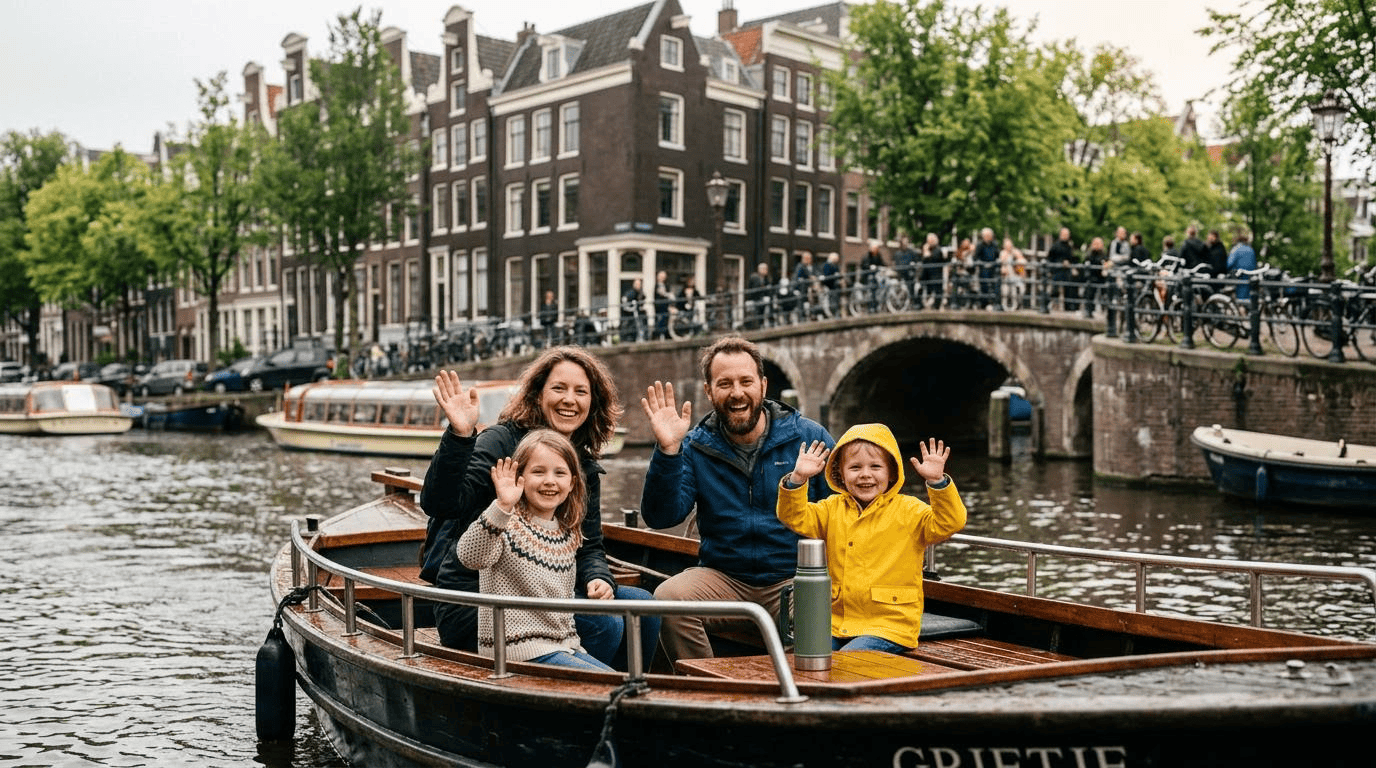
The Netherlands keeps transfers short, so small legs spend less time in transit
The Netherlands is compact. Amsterdam, Utrecht and Haarlem sit close enough for day trips from a single base, which fits the one-base rule from the first section. Streets are mostly flat, which helps strollers, and parks and playgrounds are easy to find inside cities.
The main snag is the building stock. Many older canal houses have narrow, steep stairs, and some hotels have no lift. Ask about lifts, ground-floor rooms and stroller storage before you book, because a missing lift turns every nap-time return into a carry.
A canal cruise suits children who need to sit and watch. Boats give a first-day activity that asks little of tired legs after a long flight. This Amsterdam canal cruise on Viator shows current sailing times and prices. Check the listing for age rules and whether strollers are allowed on board.
For rail days, the Interrail Child Pass covers children aged 4 to 11 inside its network, as the rail section below explains. Short Dutch legs keep seat-reservation worries low, because the trips are brief.

Italy works for children when you plan around train discounts and meal times
Italy suits children who already handle a long day. Piazzas double as playgrounds, gelato works as a bribe and an afternoon in a fountain square needs no ticket. The trade-off is distance. Moving between Rome, Florence and Venice means real train days, so keep to one big city and one slower stop.
Rail discounts help. Trenitalia lists three child rules for national trains. Children under 4 travel free without their own seat. A child under 4 with a seat gets 50% off. Children aged 4 to under 15 get 50% off the Base offer. The source page is the Trenitalia fares page, checked on 25 November 2026.
One detail is easy to miss. The 50% discount for ages 4 to under 15 applies to the Base offer, which is the flexible fare. A cheaper advance fare for an adult may still undercut the discounted Base price for a child, so price both before you book. The page shows no date on these rules, so confirm them when you search for your route.
Meals shape the day more than monuments do. Many restaurants open dinner service later than American families usually eat. A long lunch as the main meal, followed by a light early supper from a bakery or market, fits young children better than waiting for a 9 p.m. table. Pack snacks for the gaps, and the packing list for family trips covers what to carry.

Spain and Croatia suit beach-first families who accept later schedules
Both countries sell a simple idea: sea, sand and an old town for the evening. Spain's coastal resorts are built around families, with shallow swimming areas, promenades and playgrounds close to the sand. Spanish days also run late. Shops and kitchens often close in the middle of the day and reopen in the evening, so plan the nap and the pool break around that gap.
Croatia offers a rockier version. Many beaches are pebble or rock, so water shoes matter more than buckets and spades. Old towns have stone steps and polished cobbles that are hard on strollers, and a carrier is easier to manage than a pushchair. Islands add ferries, and each ferry adds a transfer block to the schedule.
Heat is the shared risk for both. Summer afternoons are best spent indoors or in the shade, and the hours either side of midday suit children better than the middle of the day. Choose lodging with air conditioning and a short walk to the sea, and book ferries and long transfers for the morning, when children are fresher.
Neither country has a verified child-fare rule in this guide, apart from the Interrail Child Pass on lines inside the pass network. Ask each bus, ferry and attraction operator about child pricing and age cut-offs before you buy.

Interrail child passes and child fares decide whether trains beat short flights
Trains suit families because there is no security queue, no baggage allowance and room to stand and stretch. The question is cost. The Interrail operator, which also sells the Eurail brand, offers a free Child Pass, and the rules are specific.
| Child age on trip start date | Rule | Detail |
|---|---|---|
| Under 4 | No pass needed | A seat is not guaranteed on crowded trains. A free Child Pass is required to reserve one |
| 4 to 11 | Free Child Pass | Add it to an adult pass at purchase |
| Extra children | Youth Pass | Up to two children travel free per adult, a third child needs a separate pass |
Source: Interrail free travel for kids, checked 25 November 2026. The page shows no effective date.
The rule that matters most is the age cut-off. Age counts on the date you choose to start the trip, not on each travel day. A child who turns 12 halfway through a pass period still counts as under 12 if the pass started before the birthday. That makes the start date worth choosing with care.
Two adults can cover up to four children on one pass each, which suits larger groups or cousins travelling together. The adult does not have to be a relative, but must be at least 18. Seat reservations on some routes carry fees outside the pass price, so add them to your budget when you compare a pass against separate tickets or a short flight.

Entry rules come first: confirm ETIAS status and passports for every child
Rules for entering the Schengen area are changing, and children are not exempt from checks. The European Commission's ETIAS page states that the system is not in operation and that no applications are collected at this point. It also says the EU will announce the start date several months before launch. The page is dated 6 October 2025, and the start date had not been set when it was checked on 25 November 2026.
Check before you travel: ETIAS status can change at short notice. Read the official ETIAS page before you pay for flights, and confirm how the rules apply to each child in your group. Check passport validity for every traveller, including infants, against the entry rules for each country on your route.
Practical steps are the same for every family. Gather every passport in one place, photograph the identity pages and keep a copy separate from the originals. Book flights only after confirming that each name matches its passport. A small spelling mismatch on a child's ticket is easier to fix at booking than at the airport.
If your route crosses several borders in one trip, treat each entry as a fresh check. A family flying into Denmark, taking a train to Germany and ending in Italy meets different practical details at each stage, even where border controls are light.

How to match europe family friendly vacations to your youngest child's age
The youngest child sets the pace. Use the table below as a starting point, then adjust for flight times from your home airport and your own budget.
| Youngest child | Start here | Why it fits | Plan around |
|---|---|---|---|
| Under 3 | Netherlands | Short hops and flat streets | Stairs and lifts at the hotel |
| 3 to 5 | Denmark | Park and city mix, free entry under 2 | Gate prices and rest days |
| 6 to 9 | Italy, Spain or Croatia | Beaches, piazzas and longer outings | Heat, late meals and ferry timing |
Source: Holiday Vistas editor's comparison based on the official fare and entry rules cited in this guide.
Pick one country, give it two bases and leave a rest block in every day. Then check the official pages for fares, entry rules and ticket age limits one more time before payment. The strongest europe family friendly vacations come from fewer moves, not more stops, and a trip that fits a five-year-old's energy usually fits everyone else's.

Frequently Asked Questions
What is the best European country for kids under 10?
No single country wins for every family. Denmark suits ages 3 to 9 when the day centres on a theme park, Italy suits children who handle longer train days, and the Netherlands suits families who want short hops and flat streets. Pick by your youngest child's age and by how many hotel changes you can tolerate.
How many countries should a family visit in one week?
One country with two bases is the safest plan for children under 10. Each hotel change uses about half a day, so two bases leave five open days in a seven-night trip. A second country adds border logistics and a new set of rules.
Do children need their own rail pass in Europe?
Children under 4 need no pass, but a free Child Pass is required to reserve them a seat. Children aged 4 to 11 on the trip start date can hold a free Child Pass, with up to two children per paying adult. Check the operator page before you buy.
Do kids need ETIAS to enter Europe?
The EU states that ETIAS is not yet in operation and that no applications are collected. Read the official ETIAS page before you book and confirm how the rules apply to each child in your group, since the start date is still to be announced.
How much does LEGOLAND Billund cost for a family?
On 25 November 2026 the park listed a 1-day ticket from 269 DKK (about $40) online and 519 DKK (about $78) at the entrance, with free entry for children under 2. Four paid tickets bought at the gate cost about 1,000 DKK (about $150) more than the online starting price.
Is Europe too much for a toddler?
It works when the plan is light. Keep to one or two bases, choose lodging with a lift or a ground-floor room, and leave a rest block in the middle of each day. Cobbled streets and stairs are the usual stroller problems, so ask the hotel about access before booking.
References
- Interrail: free travel for kids (Child Pass rules), checked 25 November 2026
- European Commission: European Travel Information and Authorisation System (ETIAS), page dated 6 October 2025, checked 25 November 2026
- LEGOLAND Billund: day tickets, checked 25 November 2026
- Trenitalia: fares and child discounts, checked 25 November 2026